Blog and news
 29
Jun
How to Build an Unforgettable Visual Identity for Your Brand
13">brand design is not a luxury; it is a strategic foundation that guarantees: Building Trust and Credibility: Consumers always gravitate towards companies that look professional. A consistent identity tells the customer that you pay attention to details, reflecting the quality of your services.Standing Out from Competitors: In a market flooded with options, your visual identity is what makes you stand out.Streamlining Marketing Efforts: When you have a clear identity, your advertising campaigns, social media designs, and even website development become easier and more impactful because you have a Brand Guideline to follow.Increasing Loyalty: The emotional connection between a customer and a brand starts with the eyes.How We Build Your Visual Identity at "Molqa"At Molqa Agency, we don't just design pretty graphics; we create strategic visual experiences that serve your business goals. Our identity design process goes through the following steps:Discovery and Analysis: We study your market, competitors, and target audience to understand the exact message that needs to be delivered.Strategy Building: We define the persona and choose colors and fonts based on consumer psychology.Design and Creativity: Our team of graphic design experts turns ideas into visual reality, starting from the logo to all printed and digital applications.Delivery and Brand Guidelines: We hand over a comprehensive brand manual that ensures you maintain brand consistency wherever it is displayed.ConclusionA strong visual identity is the silent voice of your brand, and it is the first step toward building a successful business empire. Don't leave your first impression to chance.Are you ready to take your brand to a new level of professionalism? Contact Molqa Marketing Agency today, and let us craft an unforgettable visual identity for you!
Read More 11
Jul
Which Marketing Strategies Are Right for Your Company? A Practical Growth Guide
A successful marketing strategy does not begin with choosing a platform or launching an advertisement. It begins with a clearer question: What result does your company want to achieve? The goal may be to increase sales, generate qualified leads, enter a new market, or build trust in a growing brand. Once the objective is defined, choosing the message, channel, and budget becomes more precise.Understand Your Market and AudienceBefore choosing a channel, identify who you want to reach and what influences their decisions. Go beyond basic information such as age and location. Understand the customer’s needs, objections, search behaviour, and reasons for trusting one brand over another.Review common customer questions, sales conversations, and the pages that attract the most interest. Study how competitors present their services without copying them. You should also segment customers by their needs and buying stage, not only by demographics.Create a Clear Brand MessageA campaign may attract attention, but a consistent identity makes a brand memorable. Customers should quickly understand who you are, what you offer, and why they should choose you.Define your brand promise, tone of voice, and key messages, then express them through a consistent visual identity and digital experience. When colours, designs, content, and service presentation work together, the company appears clearer and more professional.Make Content the FoundationContent is more than a schedule of social posts. It is how your company demonstrates expertise, answers customer questions, and moves prospects from interest to action.Use educational articles, short videos, and visual content during the awareness stage. For customers comparing options, provide guides, case studies, and detailed service pages. At the decision stage, use customer testimonials, FAQs, clear offers, and direct calls to action.Combine Organic Visibility and AdvertisingSearch engine optimisation helps your company build sustained visibility around the questions and services customers actively search for. Paid advertising offers faster reach and more flexible testing.Use advertising to test messages and offers, then turn successful topics into long-term articles and pages. Search data can also reveal the language and questions that show genuine intent, which can then improve paid campaigns.Design a Simple Mobile ExperienceMany customers move between advertisements, content, and service pages on their phones. Your pages should load quickly, remain easy to read, use clear buttons, and make it simple to send an enquiry or begin a conversation.A strong campaign cannot compensate for a confusing page or a long form. The advertisement, content, landing page, and contact experience are all parts of one journey.Measure Business OutcomesViews and likes can explain engagement, but they do not prove business growth on their own. Select measures that match the objective, such as qualified leads, conversion rate, customer acquisition cost, or sales value.Record the current baseline, set a clear target, and choose a review period. Test one main variable at a time, such as the headline, audience, or offer, so you can understand what caused an improvement or decline. A strong strategy is an ongoing cycle of planning, execution, measurement, and improvement.Choose the Right MixNo single channel works for every company. A business selling complex services may benefit from specialised articles, case studies, and professional platforms, while a consumer brand may need visual content, product videos, and retargeting campaigns.The right mix depends on the customer, buying cycle, budget, and goal—not on the popularity of a platform. At Malqaa, creativity and analysis come together to build marketing strategies that express your brand and connect it with the right audience
Read More 11
Jul
How Does Video Content Affect Sales and Buying Decisions?
Video can explain a complex product, demonstrate how it works, and present a real customer experience within a short time. By combining visuals, sound, and movement, video marketing can reduce uncertainty and help customers make more confident decisions.However, video alone does not guarantee higher sales. Results depend on a clear objective, a strong message, and content that matches the platform and the customer’s buying stage.Video Explains Value QuicklyBefore buying, customers want to understand what they will receive and how the product or service will solve their problem. A short explainer can answer visually what may take several paragraphs to describe, particularly for technical services or products where appearance and use matter.When the offer becomes clearer, uncertainty is less likely to prevent the customer from taking the next step. Explainers and product demonstrations can turn a list of features into benefits people understand.It Builds Trust and Reduces RiskCustomers do not buy based on information alone; they also look for evidence. Customer testimonials, filmed case studies, behind-the-scenes content, and realistic product demonstrations make a marketing promise more believable.When people see a product in use or hear a real experience, they can assess the offer with greater confidence. Authentic scenes also give the brand a human quality that text and static images may not provide on their own.It Supports Every Buying StageOne video should not be expected to achieve every objective. Give each format a specific role.To attract attention, use a short video that opens with a relevant problem or desired result. During the interest stage, offer educational or explanatory content that presents the solution. When customers compare options, use a feature demonstration, case study, or answer to a common objection.Close to the decision, customer testimonials, practical demonstrations, and direct offers become more useful. After the purchase, tutorials and onboarding videos can improve the experience and reduce repeated support questions.Where Should Video Appear?Video can support social media, product and service pages, the home page, advertising campaigns, email, and sales presentations.The platform should shape production. Fast vertical video fits mobile-first social feeds, while a service page may need a calmer and clearer explanation that leads to one specific action.What Makes a Video Sell?An effective video does not begin with a long introduction about the company. It begins with what matters to the customer. Present the problem or outcome early, keep the message focused, and use visuals that explain rather than decorate.Capture attention in the opening seconds without misleading the viewer. Show the product or result instead of only describing it, and add on-screen text for people watching without sound. Keep the visual identity consistent and end with one clear next step.How Should You Measure Its Impact?Do not judge a video by views alone. Watch the completion rate to assess the message, clicks and page visits to measure movement from interest, enquiries and qualified leads to measure demand, and conversions and sales to measure commercial impact.Use tracking links and dedicated landing pages when possible, and compare the performance of different videos. This makes it possible to improve the opening, length, message, and call to action using evidence.At Malqaa, visual content turns a brand idea into a clear story that moves the audience closer to action. An effective video is not simply a beautiful scene; it is a message with a purpose and a clear role in the sales journey
Read More 6
Sep
Why Your Company Needs Diverse Content, Not Just More Posts
Many content plans do not suffer from a lack of publishing. They suffer from repeating the same format and message. A company may post regularly, but relying on one content type limits its ability to reach different audiences and support different stages of the customer journey.Content diversity means selecting a useful mix of formats, topics, and channels for a clear purpose. It does not mean publishing everything everywhere. An article answers an in-depth search query, video explains visually, an infographic simplifies information, a case study builds trust, and email keeps the relationship active.People Consume Content DifferentlySome customers prefer a short video, while others need a detailed guide or comparison. The same person may behave differently depending on available time, device, and buying stage. Content diversity gives the message more opportunities to be discovered and understood.The goal is not to use every available content type. It is to select the mix that fits the audience, objective, and available resources. Quality and consistency matter more than having a superficial presence on every channel.Give Each Format a RoleArticles build search visibility and explain subjects in depth. Video demonstrates products, simplifies ideas, or presents human stories. Infographics and visual designs organise information and steps in a format that is easy to scan.Case studies provide practical evidence of experience, while guides and checklists help customers complete a task or make a decision. Email maintains the relationship and brings the audience back to useful content and services.The key is to connect each format with a job rather than choosing it because it is popular.Support the Customer JourneyA person discovering the company for the first time does not need the same message as someone comparing two providers. Use accessible and engaging content for awareness, educational content for evaluation, and social proof with a clear offer at the decision stage.The formats can work together. A short video raises a question, an article answers it, a case study demonstrates experience, and a service page leads to contact. Content becomes a connected system instead of a collection of isolated posts.Repurpose Without RepeatingDiversity does not require starting from zero every day. A strong article can become several social posts, a short video, an infographic, and an email. This extends the value of the idea and adapts it to the way people use different platforms.Repurposing is not copying the same text everywhere. Adjust the opening, length, design, and call to action for the platform and audience.Keep the Brand ConsistentFormats may change without weakening the identity. Keep the core messages, tone of voice, and visual principles consistent, then allow each format to express them appropriately. Customers should recognise the brand whether they watch a video, read an article, or open a presentation.Use a content calendar that identifies the objective, audience, buying stage, format, and channel for each item. This reveals imbalances: Is the plan full of awareness content but missing decision content? Does it depend on one platform? Does it speak to only one segment?Measure Each Format ProperlyDo not judge every format by the same metric. Evaluate an article through visits, reading behaviour, and conversions. Assess video through retention, views, and clicks. Connect case studies with enquiries and their influence on sales opportunities.Review results regularly and invest more in the formats that support the objective. Intelligent diversity is not equal spending across every format. It is a flexible mix shaped by evidence.At Malqaa, content is designed as one connected experience that communicates the brand’s vision and reaches both the mind and heart of its audience. The goal is not simply to produce more, but to create diverse and consistent content with a clear role
Read More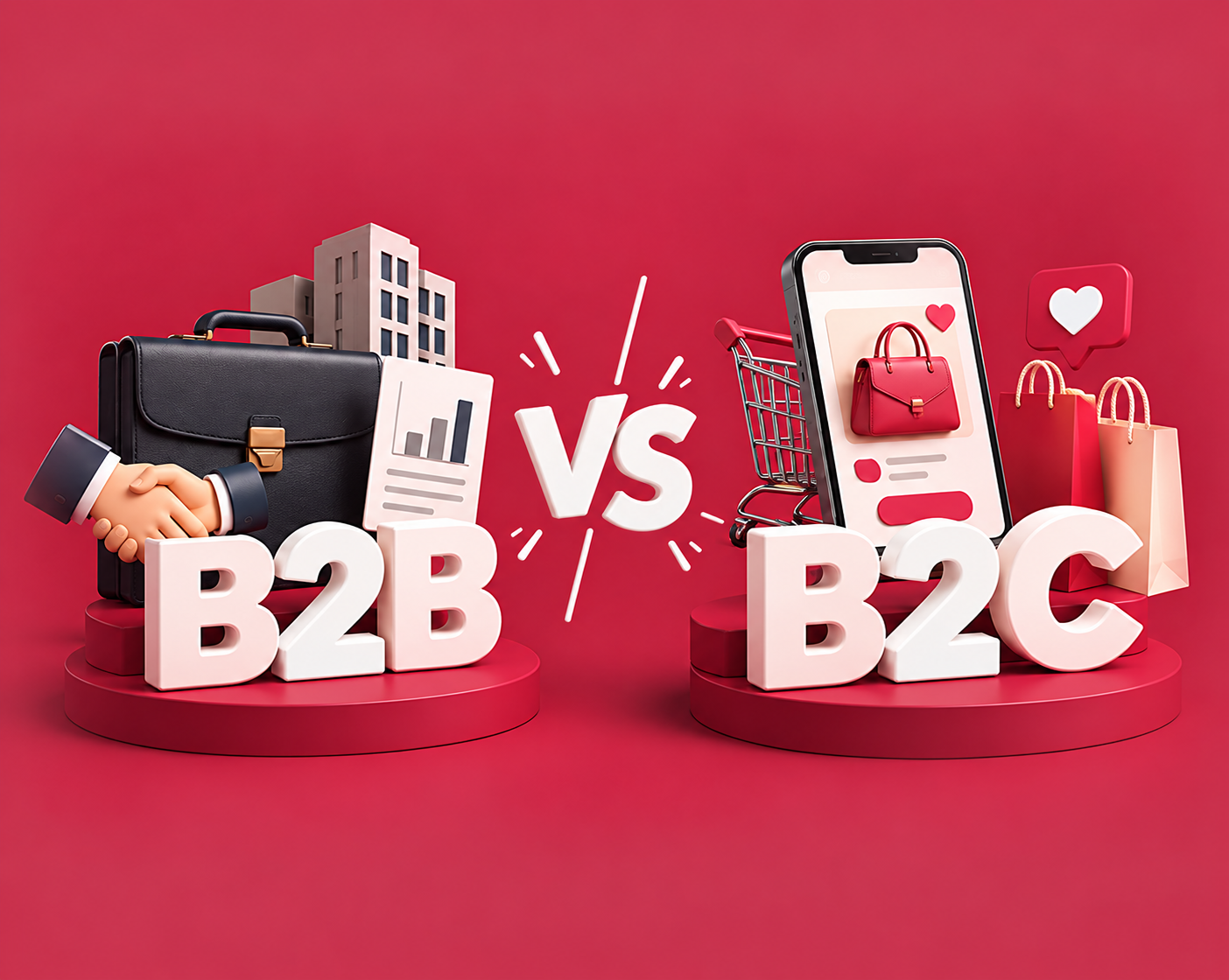 6
Sep
B2B vs B2C Marketing: The Difference That Changes Your Strategy
Business-to-business and business-to-consumer marketing use many of the same tools, including content, search, advertising, and email. However, the way these tools are used changes because the target customer, reason for buying, number of decision-makers, and length of the journey are different.B2B means marketing from one business to another, while B2C means marketing directly from a business to an individual consumer. Understanding this distinction shapes the message, evidence, channel mix, and method of measuring success.Who Is the Audience?In B2B marketing, a company speaks to an organisation, decision-maker, or buying team. The decision may involve a department manager, finance, technical specialists, and senior leadership. Content must therefore answer different questions and prove value to more than one stakeholder.In B2C marketing, the company speaks to an individual or household. Fewer people are usually involved, and the purchase may happen more quickly, particularly when the product is clear and easy to compare.How Does the Buying Decision Differ?The B2B sales cycle is generally longer and more complex. Customers focus on efficiency, return, risk reduction, implementation, and long-term value. They need clear details, a practical proposal, and evidence of experience.In B2C, the decision is more closely linked to personal needs, convenience, price, experience, and brand appeal. This does not mean B2B decisions are purely rational and B2C decisions purely emotional. Trust and emotion matter in both, but the risk and context differ.How Does the Message Change?In B2B, a decision-maker wants to understand the effect on performance: Will the solution reduce costs? Improve productivity? Can it be implemented securely? The message should be precise and supported with relevant use cases, results, and business examples.In B2C, customers need to understand the personal benefit quickly. The message should explain how the product makes life easier or better, how it differs from alternatives, and why the customer should act now.How Does the Content Change?B2B content usually supports a longer journey. Useful formats include case studies, specialist guides, demonstrations, solution pages, articles addressing specific business problems, and comparisons that help people assess options.B2C commonly benefits from product videos, user-generated content, reviews, images, short videos, seasonal campaigns, email, and personalised recommendations.How Do the Channels Differ?No channel belongs exclusively to one model, but priorities differ. B2B companies often use search, websites, professional platforms, email, events, and direct sales to build trust with accounts and decision-makers.B2C brands rely more heavily on social platforms, ecommerce, content creators, visual advertising, email, and messaging to encourage a faster decision. In both models, the right channel is the one used by the audience and connected to the intended result.How Does Measurement Differ?Important B2B measures include qualified opportunities, opportunity cost, sales-cycle length, contract value, and close rate. Marketing may need more time to demonstrate its effect because the decision moves through several stages.B2C teams may focus on conversion rate, sales, average order value, customer acquisition cost, and repeat purchase. Results may appear more quickly when the buying journey is direct.Can a Company Use Both Models?Yes. A company may offer services to organisations and products to individuals at the same time. In this situation, both audiences should not be pushed through one page, message, and journey.Create clear segments, pages, offers, and metrics for each audience. The main identity may remain consistent, but the value proposition, content, and call to action should reflect the real buying context.At Malqaa, strategy begins by understanding the person behind the decision and the action the brand wants to support. When the customer model is clear, the message, channels, and content become more precise and effective.
Read More 6
Sep
Before You Sign: How to Choose the Right Marketing Agency
Choosing a marketing agency should not begin with, “Who offers the most services?” A better question is: Who understands the problem we need to solve and has a credible way to measure progress? An agency may be highly creative but still be the wrong fit if it does not understand your market, connect its work to a business goal, or clarify each party’s responsibilities.A careful selection begins inside your company. Define the objective, budget, timeline, and available resources before comparing proposals so that every agency can be assessed using the same criteria.Define What Must ChangeAvoid a broad goal such as “We need better marketing.” Choose an observable outcome, such as more qualified enquiries, a lower customer acquisition cost, stronger search visibility, a new identity, or higher sales for a specific service.Record the current baseline. If the objective is to increase leads, what are the present number, quality, and cost? Without a starting point, neither your company nor the agency can demonstrate improvement clearly.Look for Relevant ExperienceExperience in your industry can help, but it is not the only standard. Experience with a similar challenge may be more valuable, such as launching a product, managing a long sales cycle, growing ecommerce, or repositioning a brand.Request examples showing the situation before the work, the agency’s exact contribution, the timeframe, and the result. A beautiful design or growth percentage without context is not enough.Assess How the Agency ThinksA strong partner does not jump to a solution before understanding the business. Pay attention to the questions asked. Does the team ask about lead quality, the sales cycle, competitors, and your internal capacity? Or does it offer a standard package immediately?Ask why each channel has been selected. The proposal should explain why search, content, advertising, or another activity fits your audience and objective, and how the channels will work together.Check Saudi Market UnderstandingLanguage alone is not enough. The marketing agency should understand cultural context, audience behaviour, local occasions, service expectations, and the differences between market segments.Review both Arabic and English work, and make sure the English version is written for its audience rather than translated literally. Design and digital experiences should also be mobile-friendly from the beginning.Know Who Will Do the WorkThe sales team you meet may not manage the account after signing. Ask who will be the account manager, strategist, writer, designer, and advertising specialist, and who reviews quality. Understand which work is completed internally and which is outsourced.Agree on communication channels, meeting frequency, response times, and the approval process. A clear team and workflow reduce delays and misunderstandings.Review Measurement and ReportingAsk to see a sample report before signing. It should not stop at reach and clicks. It should connect metrics to the objective and explain what happened, why it happened, and what should happen next.Agree on definitions from the beginning. What counts as a lead? How will sales be attributed? Who is responsible for setting up tracking? Clear answers make performance evaluation more accurate and fair.Compare Scope, Not Only PriceA lower proposal may exclude copywriting, production, media management, landing pages, or analytics tools. Compare deliverables, quantities, revision rounds, deadlines, exclusions, platform fees, and software costs.The question is not only, “How much does it cost?” It is also, “What are we paying for, what must we provide, and how will the scope support the goal?”Protect Account and Data OwnershipYour company should own its advertising accounts, analytics data, domain, website, brand files, and final assets according to the contract. Give the agency the access needed to work rather than allowing essential assets to be created outside your control.Document the handover process, file ownership, and removal of permissions at the end of the relationship. Clear ownership protects continuity and prevents complete dependence on one supplier.Review Contract and Exit TermsCheck the contract period, renewal, cancellation, responsibilities, deadlines, confidentiality, usage rights, and liability limitations. Exit clauses are not a sign of mistrust; they are part of a clear professional relationship.Ask how files, data, and accounts will be handed over if the engagement ends, and make sure all agreements are documented rather than left as verbal promises.Test the Working RelationshipThe strongest proposal will not succeed without collaboration. Evaluate response times, clarity, and the team’s ability to receive feedback without losing strategic direction. The agency should provide honest professional advice, while the client should provide information and approvals on time.The right marketing agency is more than a supplier completing tasks. It understands the brand, clarifies priorities, and turns creativity into work that can be evaluated. Malqaa brings identity, digital experience, marketing, and creative content together to build a stronger connection between brands and their audiences.
Read More